
I have to admit that what makes me the most uncomfortable in the debate about JD Vance and Hillbilly Elegy is the fear that I am like him.
Vance is racist, claiming he is “skeptical” of the idea of white privilege. The website for his nonprofit, Our Ohio Renewal, blames the breakup of families for a host of problems rather than the other way around. The championing of his story perpetuates the idea that a person, a poor Appalachian person specifically, can pull themselves up by the bootstraps—an idea that is precisely the opposite of what those outside the region who are suddenly so interested in Appalachia, need to hear.
It struck me that Vance is engaging in a sort of cultural appropriation, though of his own culture, in using the story of Appalachian poverty to advance his own name, political career, and wealth, without giving back much of what he gains. But my fear starts here—he may genuinely think that he is giving back, that Our Ohio Renewal and his own political ambitions are truly what the region needs. He’s not trying to be the bad guy.
What does that make me? To quote Clare Dederer out of context, “Are all ambitious artists monsters? Tiny voice: [Am I a monster?].”
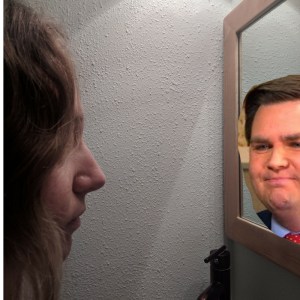
I, too, left Appalachia. It was never a question for me that I would leave. Though I loved the hills, the green, the sweet sap from our sugar maples, I knew by the time I was 10 that West Virginia was the place of my childhood, of my roots, but not where I would stay. And now, two decades later, I’ve written a book. People are listening to what I have to say. I might make some money.
I feel like an imposter when I describe myself as an Appalachian author. Others who claim that title still live there. They stayed. I feel guilt when I think of my friends who stayed, who are creating art and organic farms, protesting, sticking rainbow stickers on the windows of their businesses. They’re doing the work. Meanwhile I skipped town and still get to write about it.
Do I even get to call myself a West Virginian? I wonder almost daily.
And then there’s a microaggression.
“Where are you from?” someone will ask.
“West Virginia,” I’ll say.
The answer varies.
Sometimes it’s, “Wowww,” with a smirk, as if we’re both in on a joke.
I don’t laugh.
Sometimes it’s, “But you don’t have an accent.”
I wonder what they would think if they heard the codeswitching I do when I go home.
Sometimes it’s the classic— “Oh, near Roanoke?”
The rage I feel confirms that yes, I am a West Virginian.
Gloria Anzaldúa writes, “I feel particularly free to rebel and to rail against my culture. I fear no betrayal on my part, because… I was totally absorbed in mine…. In leaving home I did not lose touch with my origins because lo mexicano is in my system. I am a turtle, wherever I go, I carry ‘home’ on my back.”

Like Anzaldúa, my home, my culture is in my blood. I carry West Virginia with me everywhere. When I write the parts that are ugly, I write it as if I were writing about my self. But Vance thinks this too.
Saying that ignores a lot, though. It ignores the fact that even in Appalachia, Vance was still a white man. Though he certainly faced the hardships of poverty and familial addiction, when he left—when he did overcome those (and good for him for doing so!), he got to be a white man. He can imagine that the problems of poverty and addiction are self-imposed because when he left Appalachia, the privileges he did have allowed him to leave poverty and addiction behind.
In my Appalachian childhood, I was a Jewish girl. Though the intersectionality of my identities did not make things as hard for me as it did for my black peers, I was still told regularly to my face that I would go to hell. I was harassed on the school bus. I was sexually assaulted.
I won’t gloss over my own privilege. My own white skin and access to education allowed me to climb the social and economic ladder when I left the region too. But the intricacies of my identity have led me to think critically about the roots of issues (spoiler alert: the good ol’ capitalism/patriarchy mashup), rather than blame the people I grew up with for them.
Anzaldúa says, “So yes, though ‘home’ permeates every sinew and cartilage in my body, I too am afraid of going home. Though I’ll defend my… culture when they are attacked…I abhor some of my culture’s ways.” The ugly parts I share as if I own them, yes, but I try consciously to make it clear that those ugly parts result from the fists of capitalism that have grabbed at our hills for so many decades. Though I may recall the effects they have had on me, I will not blame them on my neighbors.

And what about the beauty? Isn’t that what appropriation usually is? Taking the things that are beautiful and profiting from them, without giving back to those you took it from? Because really, most of my writing about Appalachia is a love letter.
It’s not as simple as “giving back,” Vance has shown me. I will have to give back correctly—making sure, as I do in my writing not to do so in a way that blames Appalachia for its poverty and all that stems from it. I will be intentional with my financial contributions, supporting organizations, candidates, authors, and artists who advocate for the region in meaningful ways. I will be intentional with my words, remembering and portraying the agency, the grit, and the resistance so emblematic of my home among the hills.
If you liked this post, please consider signing up for my newsletter, which features links to weekly blog posts and news about my book and events!
 beccaspencedobias.com
A wonderful piece and well presented. Thanks for sharing.
Long live West Virginia!
LikeLike
This is an insightful response to Vance’s book.
LikeLike
In today’s postmodern era, “victim privilege” is power. You, not being a white male but rather a female of an oppressed ethnicity of a Jew, lash out at JD Vance who is now a wealthy, acclaimed white male who now speaks from a position of privilege and power.
Vance has been criticized, among other things, for saying that traits in his and other Appalachian’s Scot/Irish ethnic heritage contribute to some of the negative social problems in Appalachia. Critics counter that is ethnic racism. But let’s compare your situation to his. Immigrants from Scotland and Ireland were not welcomed in America, as also the case with Jewish immigrants. Indeed, as you note from personal experience in your article, Jews still experience antisemitism in America. Nonetheless, although Jews make up less than 2% of the U.S. population, Jews compared to population have a much higher percentage of wealthy people, Congressional representation, high ranking business leaders, and are very prominent in the media, arts, medicine, science, law, and even in Ivy college enrollment. Jewish contribution to American society has been substantial and beneficial.
So why is it that one ethnicity has struggled, and yours has thrived? Of course, the Scot/Irish settling in Appalachia were rural people and ended up being pawns of extractive industry, while Jews predominantly settled in urban areas. I won’t venture an answer, only to say that an intergenerational ingrained ethnic lifestyle and attitude might play a part.
Unquestionably white males have a big leg up at the “starting line.” So do children raised in functional families, which J.D. Vance did not have. One issue at hand for dealing with inequality of outcome, it seems to me, is to lessen obstacles whether family or societal. Another issue, perhaps more intractable, involves individual human agency. That is, to use an old trope, is that when the “horse is led to the water, that it drinks.” Engrained intergenerational lifestyle patterns can be difficult to change.
An honest look at Appalachia is to see serious problems. Statistics from Wood Johnson, Galup/Healthways, and all sorts of government data sources cannot be ignored. Data includes statistics related to the instability of families that is especially high in lower-educated populations such as in Appalachia.
In today’s postmodern era, “victim privilege” is power. You, not being a white male but rather a female of an oppressed ethnicity of a Jew, lash out at JD Vance who is now a wealthy, acclaimed white male who now speaks from a position of privilege and power.
Vance has been criticized, among other things, for saying that traits in his and other Appalachian’s Scot/Irish ethnic heritage contribute to some of the negative social problems in Appalachia. Critics counter that is ethnic racism. But let’s compare your situation to his. Immigrants from Scotland and Ireland were not welcomed in America, as also the case with Jewish immigrants. Indeed, as you note from personal experience in your article, Jews still experience antisemitism in America. Nonetheless, although Jews make up less than 2% of the U.S. population, Jews compared to population have a much higher percentage of wealthy people, Congressional representation, high ranking business leaders, and are very prominent in the media, arts, medicine, science, law, and even in Ivy college enrollment. Jewish contribution to American society has been substantial and beneficial.
So why is it that one ethnicity has struggled, and yours has thrived? Of course, the Scot/Irish settling in Appalachia were rural people and ended up being pawns of extractive industry, while Jews predominantly settled in urban areas. I won’t venture an answer, only to say that an intergenerational ingrained ethnic lifestyle and attitude might play a part.
Unquestionably white males have a big leg up at the “starting line.” So do children raised in functional families, which J.D. Vance did not have. One issue at hand for dealing with inequality of outcome, it seems to me, is to lessen obstacles whether family or societal. Another issue, perhaps more intractable, involves individual human agency. That is, to use an old trope, is that when the “horse is led to the water, that it drinks.” Engrained intergenerational lifestyle patterns can be difficult to change.
An honest look at Appalachia is to see serious problems. Statistics from Wood Johnson, Galup/Healthways, and all sorts of government data sources cannot be ignored. Data includes statistics related to the instability of families that is especially high in lower-educated populations such as in Appalachia. Cavalierly dismissing Vance because of viewpoints on white privilege and family breakup does not move Appalachia out of its problem sets. Instead, offer solutions that we in Appalachia can viably address.
In closing, thank you for caring about Appalachia and for letting me comment.
LikeLike