Book Review: On Homesickness by Jesse Donaldson

I like most books I read, on some level. Even if it isn’t my favorite, or if I didn’t like it enough to read the next one in the series, I can usually find something redeeming in everything I read. More than that, I’d say I like most books I read a lot. Maybe this means I’m good at picking books, or maybe this means I like reading enough that I have a very low threshold for enjoyment when it comes to literature.

Every once in a while, though, I pick up a book that sings to me– that speaks so much to me that it feels like it was written directly to my heart.  The Unbearable Lightness of Being, The Wind-up Bird Chronicle, Bird by Bird, Everything Is Illuminated, Even Cowgirls Get the Blues, and now On Homesickness by Jesse Donaldson. I want to hold it to my chest and take deep breaths until it becomes a part of me. It feels like it already is a part of me.

Each page of On Homesickness has the shape, name, and year of formation of one of Kentucky’s 120 counties on the left and a prose poem on the right. The poems detail Donaldson’s nostalgia for his home state from his new home of Oregon. So many of his sentiments give voice to my own feelings about West Virginia in my new home of California. Part of this is because the geography is so similar. We both left Appalachia for the West coast. Part of it is because Donaldson and I are both young married adults with young children. I relate so much to the culture shock Donaldson describes, ache reading the myths and legends he shares about Kentucky because they remind me so much of those from West Virginia, and also felt incredibly invested in his story as it parallels my own.  We have the same cultural references, particularly Wendell Berry. I earmarked almost every other page.

On Homesickness  made me ache in another way– one I didn’t expect. For the first time, I read a book that I so wanted to share with my father. Of course there are lots of things, lots of moments, lots of thoughts I’ve wanted to share with him, but this book…he would have loved it so much. I haven’t felt his loss like this in a while– so fresh. He’s been gone for 19 years now and it hurts that he can’t read it.

Donaldson’s book conveys so many of the feelings and themes I’d like to capture in Rock of Ages so well and I’m so glad I read it while working on the rewrite. This is a book I’ll keep on my bedside and pick up to read a page or two every once in awhile. It has earned its place next to my favorites.

What books feel like they speak directly to you?

Want emails? Sign up here!

Motivation, Accountability, and Bribery: How I Get My Writing Done

I’ve always been a responsible person. I was a conscientious student from preschool, completing extra worksheets at home with my mom just because I wanted to. This personality train persists today, and is essential for my success as a writer. After all, no one is telling me I have to write a blog post each week other than me. No one has set any deadlines for the rewrite of my novel. It would be next to impossible to write without some amount of self-directed motivation and accountability, and though these seem to come naturally to me, I know they’re really hard for some people. I decided to intentionally consider the roots of these habits and how I cultivate them.

Motivation

At the heart of all of it, is motivation. If you don’t know why you’re writing, you won’t keep writing. For me, it’s a few things: Stories come up from somewhere inside me and I can’t think about anything else until I get them out. The stories need to be told. I want to be recognized as a writer– to have people read my work and be moved, to feel like it speaks to them. I want to hold my own books in my hands. And of course, now that people are waiting for my book, the desire not to disappoint them is a motivator too. If you don’t know why you write or paint or study, or do whatever it is you’re trying to do more of, spend some time thinking about it. Verbalize it. Imagine it. Really let yourself picture what it would feel like to achieve it. Studies show our brains respond the same way to things that are vividly imagined as they do to things we really experience. Get used to the feeling, so that it really feels possible, and come back to it any time your motivation is low.

Accountability

I give myself deadlines and I treat them like external deadlines. I only let myself compromise on them in rare circumstances. Writing down goals is essential for me. I write “write” in my planner every day and cross it off when I meet my goal. If something comes up and I don’t get to my 1000 word goal in the morning like I planned, I stay up that night until I do, even though I’m the only one checking. Investing in yourself requires holding yourself accountable. Don’t give yourself excuses. That being said, make sure your goals are reasonable. They should be challenging yet realistic. If it’s a struggle to meet them every day, they’re too difficult. If you’re meeting them easily every day, they aren’t hard enough.

If you really struggle with keeping internal deadlines, make them external. Sign up for NaNoWriMo or 750Words. Get a writing buddy and check in with each other.

Bribery

Don’t be afraid to bribe yourself. Before I started the rewrite for Rock of Ages, I made a list of milestones in the book and how I would treat myself when I reached them. Everything from coffee at your favorite place to bigger gifts can do the trick.

Is self-directed work hard for you? How  do you keep yourself motivated and accountable? What would you do if you could just make yourself do it? 


The Monster in the Mirror: Appalachian Imposter Syndrome and Appropriating My Own Culture

I have to admit that what makes me the most uncomfortable in the debate about JD Vance and Hillbilly Elegy is the fear that I am like him.

Vance is racist, claiming he is “skeptical” of the idea of white privilege. The website for his nonprofit, Our Ohio Renewal, blames the breakup of families for a host of problems rather than the other way around. The championing of his story perpetuates the idea that a person, a poor Appalachian person specifically, can pull themselves up by the bootstraps—an idea that is precisely the opposite of what  those outside the region who are suddenly so interested in Appalachia, need to hear.

It struck me that Vance is engaging in a sort of cultural appropriation, though of his own culture, in using the story of Appalachian poverty to advance his own name, political career, and wealth, without giving back much of what he gains. But my fear starts here—he may genuinely think that he is giving back, that Our Ohio Renewal and his own political ambitions are truly what the region needs. He’s not trying to be the bad guy.

What does that make me? To quote Clare Dederer out of context, “Are all ambitious artists monsters? Tiny voice: [Am I a monster?].”
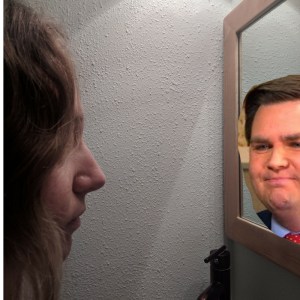
I, too, left Appalachia. It was never a question for me that I would leave. Though I loved the hills, the green, the sweet sap from our sugar maples, I knew by the time I was 10 that West Virginia was the place of my childhood, of my roots, but not where I would stay. And now, two decades later, I’ve written a book. People are listening to what I have to say. I might make some money.

I feel like an imposter when I describe myself as an Appalachian author. Others who claim that title still live there. They stayed. I feel guilt when I think of my friends who stayed, who are creating art and organic farms, protesting, sticking rainbow stickers on the windows of their businesses. They’re doing the work. Meanwhile I skipped town and still get to write about it.

Do I even get to call myself a West Virginian? I wonder almost daily.

And then there’s a microaggression.

“Where are you from?” someone will ask.

“West Virginia,” I’ll say.

The answer varies.

Sometimes it’s, “Wowww,” with a smirk, as if we’re both in on a joke.

I don’t laugh.

Sometimes it’s, “But you don’t have an accent.”

I wonder what they would think if they heard the codeswitching I do when I go home.

Sometimes it’s the classic— “Oh, near Roanoke?”

The rage I feel confirms that yes, I am a West Virginian.

Gloria Anzaldúa writes, “I feel particularly free to rebel and to rail against my culture. I fear no betrayal on my part, because… I was totally absorbed in mine…. In leaving home I did not lose touch with my origins because lo mexicano is in my system. I am a turtle, wherever I go, I carry ‘home’ on my back.”

Like Anzaldúa, my home, my culture is in my blood. I carry West Virginia with me everywhere. When I write the parts that are ugly, I write it as if I were writing about my self. But Vance thinks this too.

Saying that ignores a lot, though. It ignores the fact that even in Appalachia, Vance was still a white man. Though he certainly faced the hardships of poverty and familial addiction, when he left—when he did overcome those (and good for him for doing so!), he got to be a white man. He can imagine that the problems of poverty and addiction are self-imposed because when he left Appalachia, the privileges he did have allowed him to leave poverty and addiction behind.

In my Appalachian childhood, I was a Jewish girl. Though the intersectionality of my identities did not make things as hard for me as it did for my black peers, I was still told regularly to my face that I would go to hell. I was harassed on the school bus. I was sexually assaulted.

I won’t gloss over my own privilege. My own white skin and access to education allowed me to climb the social and economic ladder when I left the region too. But the intricacies of my identity have led me to think critically about the roots of issues (spoiler alert: the good ol’ capitalism/patriarchy mashup), rather than blame the people I grew up with for them.

Anzaldúa says, “So yes, though ‘home’ permeates every sinew and cartilage in my body, I too am afraid of going home. Though I’ll defend my… culture when they are attacked…I abhor some of my culture’s ways.” The ugly parts I share as if I own them, yes, but I try consciously to make it clear that those ugly parts result from the fists of capitalism that have grabbed at our hills for so many decades. Though I may recall the effects they have had on me, I will not blame them on my neighbors.

And what about the beauty? Isn’t that what appropriation usually is? Taking the things that are beautiful and profiting from them, without giving back to those you took it from? Because really, most of my writing about Appalachia is a love letter.

It’s not as simple as “giving back,” Vance has shown me. I will have to give back correctly—making sure, as I do in my writing not to do so in a way that blames Appalachia for its poverty and all that stems from it. I will be intentional with my financial contributions, supporting organizations, candidates, authors, and artists who advocate for the region in meaningful ways. I will be intentional with my words, remembering and portraying the agency, the grit, and the resistance so emblematic of my home among the hills.

If you liked this post, please consider signing up for my newsletter, which features links to weekly blog posts and news about my book and events!


Blurring the Lines Between Self-Publishing and Traditional Publishing


I spoke recently on a panel on “The Art of Publishing” alongside a self-published author, an author with books both traditionally and self-published, the editor of a weekly newspaper, and the owner of a small press. More than anything, this conversation led me to consider the labels we use when discussing different means of publication. A vast amount of information is available on “traditional publishing vs. self-publishing.” You can consider the pros and cons of each, their histories, statistics, and anything else you could possibly want to know to help you decide which road to go down. I certainly imagined myself standing at a forked path with manuscript in hand while I was obsessively pouring over those sites.

What these blogs and Facebook posts don’t convey is that these are not the only two publishing routes that exist, and that increasingly, the other options are blurring the boundaries between what seemed like two distinct choices.

Traditional publishing used to just be “publishing.” There were a limited number of people in the world who had access to the physical resources needed to print and distribute a book. If you wanted to publish your writing, they acted as the gatekeepers. Of course people have hand-written and distributed writing for a long time, but publishing houses, with Richard Hoe’s patent of the first rotary press in 1846, could circulate paperbacks, introduced to the United States only one year earlier, widely.

Technology– accessible word processors, printers, computers, the Internet—made it possible for a vast number of people to create, replicate, and distribute their work on a broad scale. The self-publishing/ traditional publishing dichotomy was born. Large publishers were no longer required in order to access these tools, and their role changed to that of a content filter and voucher. They came to be seen as quality control—a way to sort through the enormous sea of work that was now available around the world.

But there is more good work out there than the Big Five publishers can publish. Small publishers began challenging that monopoly and filling some of that gap. Even with the numerous small presses that now exist, there is still more great writing, and potentially great writing, than they can manage. Publication sometimes relies on politics—who you know, how much money and access you already have, etc., as a filter because publishers are humans and humans can only read, edit, design, market, and distribute so much. But anyone has access to these tools. People can publish their work themselves. And a lot of it is good! What challenges outdated ideas about the connection between publishing and quality even further is that increasingly folks are choosing to publish their work independently not as a compromise or act of settling, but intentionally. There are a number of reasons some prefer to publish books themselves, including viewing it as a middle finger to the politics and gatekeeping of traditional publishing.

So publishing is no longer necessarily about who can physically publish and distribute a book. And it’s no longer necessarily an indicator of quality. Where does that leave us?

With choices! Here we are again at that fork– You can pursue traditional publishing with a large house or small press or you can publish your book yourself. But there are choices now that blur the line between these two. My first novel, Rock of Ages, is in production with Inkshares, a crowdfunding platform for books. In this model, authors who secure 750 preorders within a set timeframe receive publishing services from the company including cover design, developmental and copyediting, marketing and distribution. Crowdfunding puts the key to that golden gate in the hands of authors. Instead of standing like a sentinel in front of the opening, platforms like Inkshares step aside and ask “Can you reach high enough to unlock the gate yourself?”

The new venture Writing Bloc is taking on, the cooperative publishing model, is taking that a step further. We’re working as a team to write, edit, design, market, and distribute our own work. Like self-publishing, we’re eschewing the need for someone to do it all for us. Instead we’re utilizing the expertise and work ethic of our group as a unit to publish our own quality content. We are taking ownership of the gate and everything inside. But at what point does this kind of venture become more like traditional publishing than self-publishing? After all, we are developing contracts, establishing content guidelines, and hopefully will eventually be distributing royalties. As Robert Batten writes, “publishers are people.” Batten is emphasizing that in order to get in with the company, The Entity, you must first win over the people who make up that entity, but remembering that publishers are people also challenges their hegemonic power.  Publishing houses are not gods. They no longer have a monopoly on resources and they’ve never had a monopoly on quality. They are groups of people who remain the gatekeepers simply because they’ve appointed themselves such and we’ve continued to go along with it.  So does it matter when we cross that line when the line is increasingly arbitrary?

What it boils down to is that the labels are becoming irrelevant. I made a comment on the panel that had all of the participants nodding. One of the amazing advantages of having access to many means of publishing means that you don’t have to write to a target audience if you don’t want to. You can write the book that you want to write—the story that needs to be written—and then find your target audience. When you put your book out into the world you want editing, design, marketing, and the validation that comes from people enjoying your work. Increasingly, those are at our fingertips in a number of innovative configurations. You may not have an audience of tens of thousands. But amongst the billions of people in the world, you probably have an audience of at least hundreds. What is important is creating exceptional books and getting them into the hands of people who will find meaning and value in them, however we do that.