Nature as Birthright

We returned yesterday from our annual trip to West Virginia, and though it’s nice to come home– to my own bed, to my own kitchen, to my own routine, it’s always sad to leave some things in the Mountain State behind. This trip was particularly wonderful. I spent lots of time with my Grandma, saw several friends and family members, documented part of the trip for the Travelin’ Appalachians Revue Instagram, found some great primary sources for my novel, and learned a lot about my hometown from the local historical society. For my children, it was wonderful because of the time they spent outside.

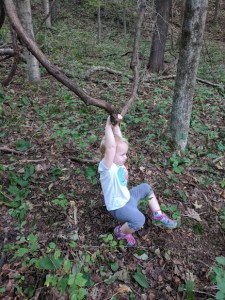
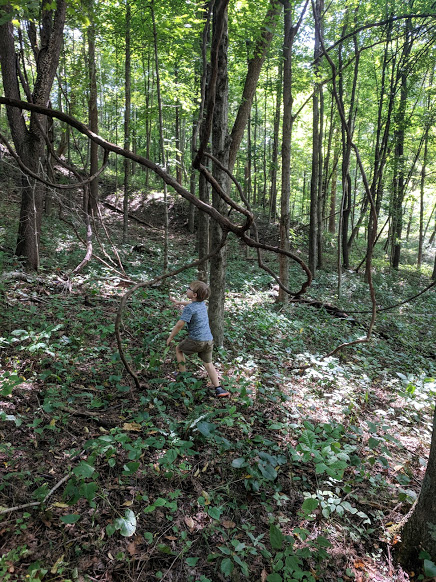
I’ve heard a lot about “Nature Deficit Disorder,” a term coined by Richard Louv in his book Last Child in the Woods. In my training as a Tinkergarten leader, I learned something jarring– children in my generation spent an average of 30 minutes outside per day (even this seems shockingly low to me). Children now spend an average of nine. My children spend time in our yard and in parks. We go on hikes. But there is something totally different about just being in the real, undeveloped, unmanicured, untamed wilderness– of having time to explore and take risks and discover. And watching my children do those things in the same place that I did as a child was so moving. It’s their birthright, I realized. To climb vines and throw sticks on this same piece of land that their mom and their grandpa did.

Of course this gets into issues of land appropriation from native people. My part of West Virginia belonged to the Mound People first, and then to other native tribes. A book published in 1907 about my county’s history claims that these tribes actually left before it was resettled by white settlers, which does make me feel a little better if it’s true, but I still want to be clear that I don’t believe in manifest destiny when I talk about a birthright. Rather, it’s everyone’s birthright to spend time in the wild, particularly in the place where their ancestors did the same. In fact, that’s part of why the theft of homeland is such an atrocity. Land and home and place are such a part of us– integrated into our consciousness and DNA the same way trauma can be. If I visited the village in the Ukraine where some of my ancestors lived, I think a part of me would recognize it, would sing “Yes! This place is a part of you.” I think it’s why so many people feel that draw– to return to their ancestral lands.

So we’ll keep going back, keep intentionally giving them this time, this place.

Did you have unstructured play in the wilderness as a kid? What did you learn? How do you feel about it now?

The Monster in the Mirror: Appalachian Imposter Syndrome and Appropriating My Own Culture

I have to admit that what makes me the most uncomfortable in the debate about JD Vance and Hillbilly Elegy is the fear that I am like him.

Vance is racist, claiming he is “skeptical” of the idea of white privilege. The website for his nonprofit, Our Ohio Renewal, blames the breakup of families for a host of problems rather than the other way around. The championing of his story perpetuates the idea that a person, a poor Appalachian person specifically, can pull themselves up by the bootstraps—an idea that is precisely the opposite of what  those outside the region who are suddenly so interested in Appalachia, need to hear.

It struck me that Vance is engaging in a sort of cultural appropriation, though of his own culture, in using the story of Appalachian poverty to advance his own name, political career, and wealth, without giving back much of what he gains. But my fear starts here—he may genuinely think that he is giving back, that Our Ohio Renewal and his own political ambitions are truly what the region needs. He’s not trying to be the bad guy.

What does that make me? To quote Clare Dederer out of context, “Are all ambitious artists monsters? Tiny voice: [Am I a monster?].”
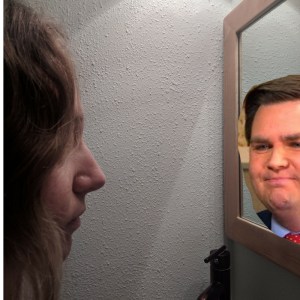
I, too, left Appalachia. It was never a question for me that I would leave. Though I loved the hills, the green, the sweet sap from our sugar maples, I knew by the time I was 10 that West Virginia was the place of my childhood, of my roots, but not where I would stay. And now, two decades later, I’ve written a book. People are listening to what I have to say. I might make some money.

I feel like an imposter when I describe myself as an Appalachian author. Others who claim that title still live there. They stayed. I feel guilt when I think of my friends who stayed, who are creating art and organic farms, protesting, sticking rainbow stickers on the windows of their businesses. They’re doing the work. Meanwhile I skipped town and still get to write about it.

Do I even get to call myself a West Virginian? I wonder almost daily.

And then there’s a microaggression.

“Where are you from?” someone will ask.

“West Virginia,” I’ll say.

The answer varies.

Sometimes it’s, “Wowww,” with a smirk, as if we’re both in on a joke.

I don’t laugh.

Sometimes it’s, “But you don’t have an accent.”

I wonder what they would think if they heard the codeswitching I do when I go home.

Sometimes it’s the classic— “Oh, near Roanoke?”

The rage I feel confirms that yes, I am a West Virginian.

Gloria Anzaldúa writes, “I feel particularly free to rebel and to rail against my culture. I fear no betrayal on my part, because… I was totally absorbed in mine…. In leaving home I did not lose touch with my origins because lo mexicano is in my system. I am a turtle, wherever I go, I carry ‘home’ on my back.”
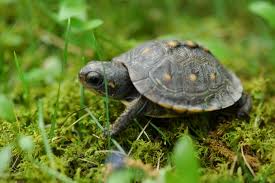
Like Anzaldúa, my home, my culture is in my blood. I carry West Virginia with me everywhere. When I write the parts that are ugly, I write it as if I were writing about my self. But Vance thinks this too.

Saying that ignores a lot, though. It ignores the fact that even in Appalachia, Vance was still a white man. Though he certainly faced the hardships of poverty and familial addiction, when he left—when he did overcome those (and good for him for doing so!), he got to be a white man. He can imagine that the problems of poverty and addiction are self-imposed because when he left Appalachia, the privileges he did have allowed him to leave poverty and addiction behind.

In my Appalachian childhood, I was a Jewish girl. Though the intersectionality of my identities did not make things as hard for me as it did for my black peers, I was still told regularly to my face that I would go to hell. I was harassed on the school bus. I was sexually assaulted.

I won’t gloss over my own privilege. My own white skin and access to education allowed me to climb the social and economic ladder when I left the region too. But the intricacies of my identity have led me to think critically about the roots of issues (spoiler alert: the good ol’ capitalism/patriarchy mashup), rather than blame the people I grew up with for them.

Anzaldúa says, “So yes, though ‘home’ permeates every sinew and cartilage in my body, I too am afraid of going home. Though I’ll defend my… culture when they are attacked…I abhor some of my culture’s ways.” The ugly parts I share as if I own them, yes, but I try consciously to make it clear that those ugly parts result from the fists of capitalism that have grabbed at our hills for so many decades. Though I may recall the effects they have had on me, I will not blame them on my neighbors.

And what about the beauty? Isn’t that what appropriation usually is? Taking the things that are beautiful and profiting from them, without giving back to those you took it from? Because really, most of my writing about Appalachia is a love letter.

It’s not as simple as “giving back,” Vance has shown me. I will have to give back correctly—making sure, as I do in my writing not to do so in a way that blames Appalachia for its poverty and all that stems from it. I will be intentional with my financial contributions, supporting organizations, candidates, authors, and artists who advocate for the region in meaningful ways. I will be intentional with my words, remembering and portraying the agency, the grit, and the resistance so emblematic of my home among the hills.

If you liked this post, please consider signing up for my newsletter, which features links to weekly blog posts and news about my book and events!
 

To S’Mores!

S’mores.

Summer.

Summer.

S’mores.

The words even sound kind of alike, at least if you pronounce the food the way I do, as if it weren’t a contraction: Suh-mores. Some mores. My husband laughs when I say it, insisting it’s “smoores” all squished together.

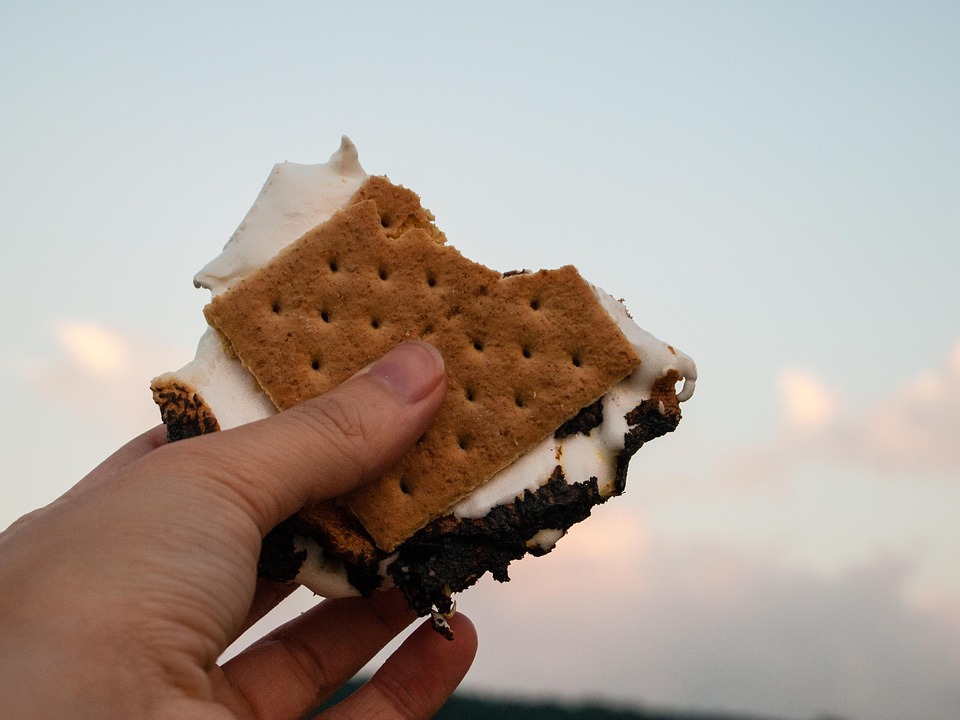
However you pronounce them, s’mores and summer are inextricable. I love everything about the treat– the whole process. I love holding the stick over the flame, waiting patiently for golden brown. I was never one to burn my marshmallow on purpose. No way.

I love moving clockwise around the campfire to avoid getting smoke in my eyes. “Smoke follows beauty,”  someone said once when I was a kid, and I took it to heart, feeling a tiny smugness when I again had to squint, believing, like kids who are told constantly that they are beautiful and wonderful do, that there was something unique and special about me, something so inherent that even the elements couldn’t deny it.

I love the way the chocolate melts when the marshmallow touches it and the way the grahm cracker breaks, crumbling in your hand or on the plate as you take a bite, the crunch contrasting with the chewiness and the gooey goodness. All of it. It’s all so fun and delicious and so a part of my favorite season that making s’mores has become almost a sacred ritual. So when I learned Trader Joe’s has vegan marshmallows, I was pretty excited.

Making s’mores with my kids is the best, as is doing anything with them that I loved to do as a kid. We went to a party when I was little. The kids were in the woods roasting marshmallows and the adults were somewhere else and I felt very grownup being allowed to stay with the big kids for this ritual. Before walking away, my mom told me I could have three marshmallows. I remember so vividly the miscounting I did that night– one of my first and only memories of being truly sneaky. “One,” I would say to myself after three or four marshmallows. “Two,” I’d say after a few more. The funny part is that I bothered counting. Instead of just breaking the rules, I had to lie to myself. I was already very much me.

It makes me wonder, too, about my children– their personalities, their inner worlds and monologues. What are they saying to themselves? It makes me think too, about the differences in our childhoods. How old was I at this party in the woods? How far was the campfire from the adults? Am I misremembering the sense of independence because I was so little or was I really out in the woods by a fire without any adults nearby? This article has been making the rounds in my circles this week, and it makes me think again, as I do pretty regularly, about parenting right now, in this place and time. Would I let my kids roast marshmallows with older kids out of my sight? How old would they have to be? Is my hesitation about this a sign of different childhood settings, different times, or some combination of those?

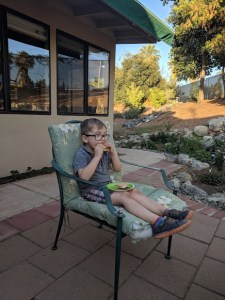
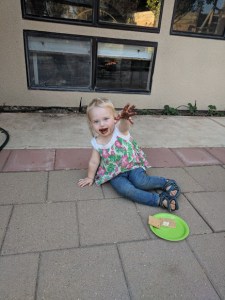
It isn’t about them eating too many marshmallows, I’m fairly certain, so for now, I will give them s’mores. Some more. Some more s’mores.

How do you pronounce s’mores? Do you have any memories of being sneaky as a little kid? Tell me about them in the comments!


Settling In, Opening Up: How New Spaces Can Make Space For New Routines (And Vice Versa)

We’ve been in our new house for about three weeks now, long enough to establish some new routines. But it’s all still new enough that I’m aware of the newness pretty constantly. And that newness–that consciousness of newness, leaves a space for newness in myself as well.

When I typed the name of my preferred grocery chain into maps, two came up, both 1.8 miles from our new home. I selected one and drove to it. The next week, when our fridge was starting to look empty again, I drove to the same location. I knew where it was already. I realized this is how years of habits are formed. Though both locations are 1.8 miles from our door, I had already settled on the one that will be “our store.”

For the first couple weeks here, everything I visited– that store, the library, downtown, felt a little bit like an island. I would listen to the navigation on my phone and follow the directions but I didn’t quite see how everything fit together. The map of our new community is starting to piece itself together in my mind now. It’s amazing how our brains can take these bits of spatial information and gradually build a more complete and connected sense of place. Eventually we hold whole neighborhoods, whole cities inside ourselves.

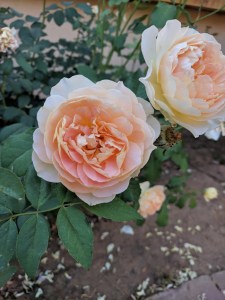
Roses in our new yard

Being in the in-between– being aware of that process– has challenged me to take advantage of this time of neuroplasticity. I’m consciously establishing new routines that I want to be a part of me in this new place– consciously taking good care of our home, turning off my phone before I go to sleep and waiting as long as possible to turn it on in the morning, writing every day, listening to audiobooks, building community.

You don’t have to move to get into this mindset of opening. Just shake up your habits and your routines, the ones that you don’t even think about. Help yourself wake up. Park on the other side of the garage. Sleep on the other side of the bed. Take a different street to your kid’s school. Go to the other grocery store. I think I will next time.

What will you do to turn off the autopilot? What will you create when you do? Please let me know in the comments. I’d love to hear from you!

Be sure to sign up here for emails about blog posts, news, and more!