There’s something we might be overlooking in our character development as writers.
We all know about character arcs. Characters need to change over the course of a story. When I received my developmental edit letter for Rock of Ages, my editor conveyed that even the jerk boyfriend in my story needed to have more depth, to show an arc. It could go downward, certainly, but he needed to change. Protagonists certainly have to learn or grow or change in some way. In good writing, all of the characters have arcs and end up at least a little different by the end of the book.
But what about the children?
I’m not talking about children’s or young adult books, obviously. So many of those authors are amazing at creating complex characters and showing these characters grow, learn, develop, and change. I’m talking about books written for adults with adults as the main characters but that have children as supporting characters. It’s hard enough to think of adult fiction that features kids meaningfully, which is strange because there are a lot of kids around us, but it’s even harder to think of examples of adult fiction with kids who show growth and change over the course of the book.
Children in books should not function only as accessories or a plot device. Children are just as complex, have just as much depth, as adults. More importantly, they change a lot faster. Their development happens simply as a matter of time– it doesn’t depend on external circumstances.
So here are some tips for adding complexity to young characters in an adult-centric book.
Read About Child Development 
The human brain is amazing and the ways we develop early on are absolutely fascinating! How much time passes in your book? How old is the child in your book at the beginning and how old are they at the end? Do some research! Read about child development at those ages. Demonstrate those changing abilities in your writing. Maybe at the beginning of the book a baby doesn’t understand object permanence and cries whenever her mother leaves the room but by the end, she understands she’ll return shortly. Maybe a child who doesn’t grasp the difference between fantasy and reality is starting to comprehend this by the end.
Talk to a Kid
If you’re writing about a child but haven’t spent much time with one their age, see if you know one you can visit or speak to on the phone. Take note of their mannerisms, pronunciations, and sentence structure. 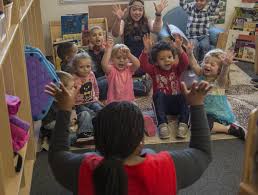
Let Them Surprise You
Kids in books can do things that would be more out of character for adults because they are changing constantly. Just because a child in a book sleeps with the lights on every night for the first half of the story doesn’t mean they can’t suddenly decide to turn them off. A five year old who is outgoing may become a five and a half year old who is more reserved. I’m not saying to make your young character do whatever you want. They should have a personality and mannerisims and tendencies, but they can diverge from those more easily than you could get away with with an adult character. You can have the adults around them react with surprise, astonishment, or reflection to highlight this difference.
Read Good Kids
Get inspired by books with good young characters. This may mean reading children’s, middle grade, or young adult books, but try to find adult-centric books as well. I recently read Sing, Unburied, Sing by Jesmyn Ward and was impressed with the character Kayla (or Michaela, depending on who you ask.)
Oskar of Extremely Loud and Incredibly Close is a fantastic character, though this book is a little different since he’s the protagonist. Jonathan Safran Foer does this well in another of his books, Here I Am, too, in which the kids are secondary characters but still complex.
I have a hard time thinking of other good examples, which might show what a gap there is. What have you read with good kid characters?




 beccaspencedobias.com