Book Review: On Homesickness by Jesse Donaldson

I like most books I read, on some level. Even if it isn’t my favorite, or if I didn’t like it enough to read the next one in the series, I can usually find something redeeming in everything I read. More than that, I’d say I like most books I read a lot. Maybe this means I’m good at picking books, or maybe this means I like reading enough that I have a very low threshold for enjoyment when it comes to literature.

Every once in a while, though, I pick up a book that sings to me– that speaks so much to me that it feels like it was written directly to my heart.  The Unbearable Lightness of Being, The Wind-up Bird Chronicle, Bird by Bird, Everything Is Illuminated, Even Cowgirls Get the Blues, and now On Homesickness by Jesse Donaldson. I want to hold it to my chest and take deep breaths until it becomes a part of me. It feels like it already is a part of me.

Each page of On Homesickness has the shape, name, and year of formation of one of Kentucky’s 120 counties on the left and a prose poem on the right. The poems detail Donaldson’s nostalgia for his home state from his new home of Oregon. So many of his sentiments give voice to my own feelings about West Virginia in my new home of California. Part of this is because the geography is so similar. We both left Appalachia for the West coast. Part of it is because Donaldson and I are both young married adults with young children. I relate so much to the culture shock Donaldson describes, ache reading the myths and legends he shares about Kentucky because they remind me so much of those from West Virginia, and also felt incredibly invested in his story as it parallels my own.  We have the same cultural references, particularly Wendell Berry. I earmarked almost every other page.

On Homesickness  made me ache in another way– one I didn’t expect. For the first time, I read a book that I so wanted to share with my father. Of course there are lots of things, lots of moments, lots of thoughts I’ve wanted to share with him, but this book…he would have loved it so much. I haven’t felt his loss like this in a while– so fresh. He’s been gone for 19 years now and it hurts that he can’t read it.

Donaldson’s book conveys so many of the feelings and themes I’d like to capture in Rock of Ages so well and I’m so glad I read it while working on the rewrite. This is a book I’ll keep on my bedside and pick up to read a page or two every once in awhile. It has earned its place next to my favorites.

What books feel like they speak directly to you?

Want emails? Sign up here!
Nature as Birthright

We returned yesterday from our annual trip to West Virginia, and though it’s nice to come home– to my own bed, to my own kitchen, to my own routine, it’s always sad to leave some things in the Mountain State behind. This trip was particularly wonderful. I spent lots of time with my Grandma, saw several friends and family members, documented part of the trip for the Travelin’ Appalachians Revue Instagram, found some great primary sources for my novel, and learned a lot about my hometown from the local historical society. For my children, it was wonderful because of the time they spent outside.

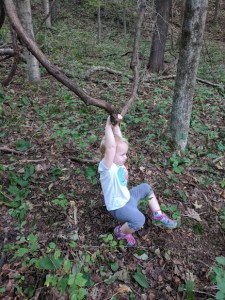
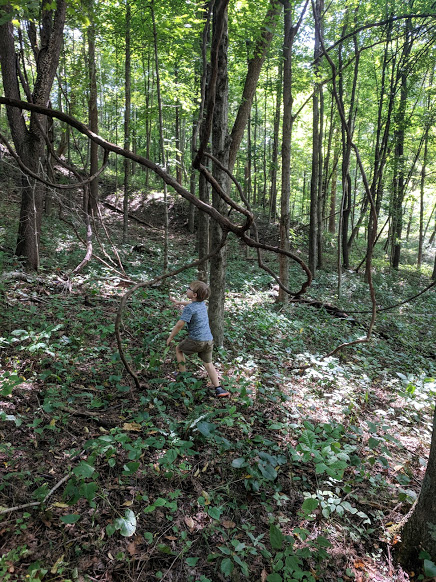
I’ve heard a lot about “Nature Deficit Disorder,” a term coined by Richard Louv in his book Last Child in the Woods. In my training as a Tinkergarten leader, I learned something jarring– children in my generation spent an average of 30 minutes outside per day (even this seems shockingly low to me). Children now spend an average of nine. My children spend time in our yard and in parks. We go on hikes. But there is something totally different about just being in the real, undeveloped, unmanicured, untamed wilderness– of having time to explore and take risks and discover. And watching my children do those things in the same place that I did as a child was so moving. It’s their birthright, I realized. To climb vines and throw sticks on this same piece of land that their mom and their grandpa did.

Of course this gets into issues of land appropriation from native people. My part of West Virginia belonged to the Mound People first, and then to other native tribes. A book published in 1907 about my county’s history claims that these tribes actually left before it was resettled by white settlers, which does make me feel a little better if it’s true, but I still want to be clear that I don’t believe in manifest destiny when I talk about a birthright. Rather, it’s everyone’s birthright to spend time in the wild, particularly in the place where their ancestors did the same. In fact, that’s part of why the theft of homeland is such an atrocity. Land and home and place are such a part of us– integrated into our consciousness and DNA the same way trauma can be. If I visited the village in the Ukraine where some of my ancestors lived, I think a part of me would recognize it, would sing “Yes! This place is a part of you.” I think it’s why so many people feel that draw– to return to their ancestral lands.

So we’ll keep going back, keep intentionally giving them this time, this place.

Did you have unstructured play in the wilderness as a kid? What did you learn? How do you feel about it now?

A Year of Uke: Lessons from 365 Days of Strumming and Humming

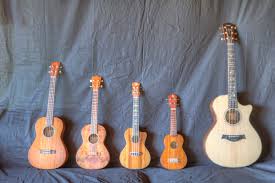
I received my ukulele for my birthday last year, which means I’ve been playing for about a year now. In that time I’ve gone from strumming my first simple chords to fingerpicking some pretty complex melodies. A year with the ukulele has taught me more than some songs, though. It’s changed the way I think about music and myself.

People Can (And Will) Be Sexist About Anything

It doesn’t take much Googling ukulele stuff to find people talking condescendingly about the young women who have happily adopted the uke as their instrument of choice and perform fun covers on YouTube, making fun of them for being cute and quirky, and subsequently dismissing the ukulele as a serious instrument. I occasionally find myself embarrassed when telling people that I play the ukulele, not wanting to be lumped in with what is seen as some cutesy trend.

To anyone who has engaged in this crap, I’ll say a few things:

  1. It’s pretty fun to be cute and quirky. Don’t knock it until you’ve tried it.
  2. You’re being sexist. “Quirky is a thinly disguised usually-gendered complement-insult. It’s used as a way to simultaneously be attracted to someone and patronize them.
  3. You’re being sexist. Dismissing women for doing “easy” things is bullshit. You can pick up on the basics of uke quickly, it’s true, but many of the women sharing videos are incredibly talented.
  4. You’re being sexist. After learning a few basic chords, playing the ukulele is at least as complicated as playing power chords on a guitar, and I don’t see nearly as much genderized critique of the punk bros doing that.
  5.  You’re being sexist. Dismissing a whole instrument because it’s seen as being associated with a certain gender just shows how rigid you are about stupid gender roles. Get over it. Or don’t. You’re missing out.

Annnnnyway. Moving on from my rant.

There Doesn’t Have to Be An Endgame

When I played instruments as a teenager, it was always about getting somewhere. Perfecting the solo for jazz band. Forming a band with friends and playing shows. It was always about playing for other people. Maybe it’s just the difference between being a teenager and being an adult, but I practice the ukulele for its own sake now. It’s like I finally get the inherent value of making music, which has helped me understand the advice I’ve read about writing for writing’s sake more deeply. If I play for or with other people now, it’s to enjoy it in the moment. I like learning hard songs just for the satisfaction of it, not because I plan to put on a show or become a YouTube sensation. It’s pretty cool to have a hobby that I enjoy just because it’s fun and it makes me strive for that with writing and my other interests too.

It’s All About Family

I got into ukulele because my mom and stepdad started playing and they were having such a good time with it. Now, when they visit, playing with them is the best! It’s so great sharing a passion with my mom, talking about what we’re working on, sending each other chords for songs. I’ve got the kids in on it too, and it’s amazing when they jam with me on shakers and kazoos! Playing music as a family is seriously one of the best things I can imagine.

This next year, I’d like to play uke at a strum. I’m sure the energy of playing with a group of people is fantastic. I plan on working more on my fingerpicking and on my ability to improvise. This instrument has brought me closer to the joy of music for music’s sake and I’m so thankful.

Do you play an instrument? What does it mean to you? Tell me in the comments!


To S’Mores!

S’mores.

Summer.

Summer.

S’mores.

The words even sound kind of alike, at least if you pronounce the food the way I do, as if it weren’t a contraction: Suh-mores. Some mores. My husband laughs when I say it, insisting it’s “smoores” all squished together.

However you pronounce them, s’mores and summer are inextricable. I love everything about the treat– the whole process. I love holding the stick over the flame, waiting patiently for golden brown. I was never one to burn my marshmallow on purpose. No way.

I love moving clockwise around the campfire to avoid getting smoke in my eyes. “Smoke follows beauty,”  someone said once when I was a kid, and I took it to heart, feeling a tiny smugness when I again had to squint, believing, like kids who are told constantly that they are beautiful and wonderful do, that there was something unique and special about me, something so inherent that even the elements couldn’t deny it.

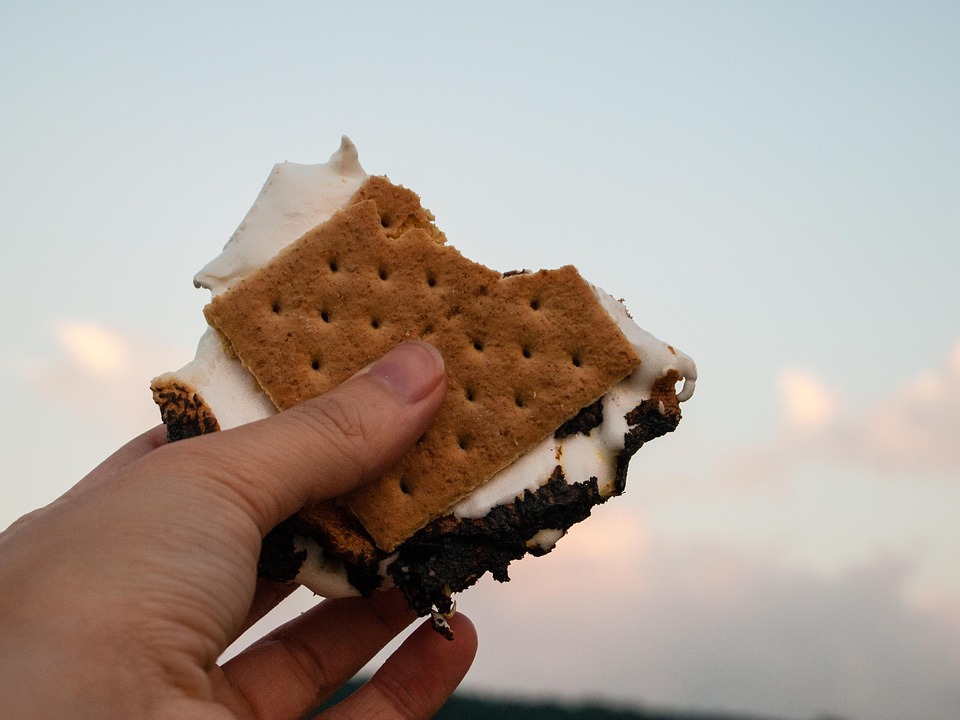
I love the way the chocolate melts when the marshmallow touches it and the way the grahm cracker breaks, crumbling in your hand or on the plate as you take a bite, the crunch contrasting with the chewiness and the gooey goodness. All of it. It’s all so fun and delicious and so a part of my favorite season that making s’mores has become almost a sacred ritual. So when I learned Trader Joe’s has vegan marshmallows, I was pretty excited.

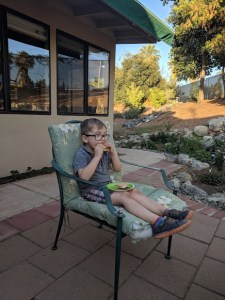
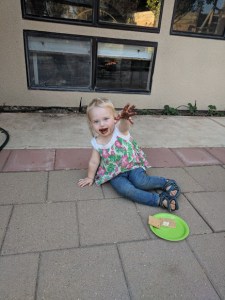
Making s’mores with my kids is the best, as is doing anything with them that I loved to do as a kid. We went to a party when I was little. The kids were in the woods roasting marshmallows and the adults were somewhere else and I felt very grownup being allowed to stay with the big kids for this ritual. Before walking away, my mom told me I could have three marshmallows. I remember so vividly the miscounting I did that night– one of my first and only memories of being truly sneaky. “One,” I would say to myself after three or four marshmallows. “Two,” I’d say after a few more. The funny part is that I bothered counting. Instead of just breaking the rules, I had to lie to myself. I was already very much me.

It makes me wonder, too, about my children– their personalities, their inner worlds and monologues. What are they saying to themselves? It makes me think too, about the differences in our childhoods. How old was I at this party in the woods? How far was the campfire from the adults? Am I misremembering the sense of independence because I was so little or was I really out in the woods by a fire without any adults nearby? This article has been making the rounds in my circles this week, and it makes me think again, as I do pretty regularly, about parenting right now, in this place and time. Would I let my kids roast marshmallows with older kids out of my sight? How old would they have to be? Is my hesitation about this a sign of different childhood settings, different times, or some combination of those?

It isn’t about them eating too many marshmallows, I’m fairly certain, so for now, I will give them s’mores. Some more. Some more s’mores.

How do you pronounce s’mores? Do you have any memories of being sneaky as a little kid? Tell me about them in the comments!


On the Eve of my 32nd Birthday

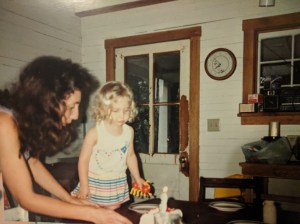
Tonight I am the exact age that my mother was when she gave birth to me. Up until now, until this day, I thought that she was older when she had had me, as in more of a grownup.

At some point, as a teenager maybe, I asked her when she first felt like a grownup. She told me it wasn’t until she had kids. I birthed my children when I was 27 and 30. I grew up– became a mother– came to embody responsibility and wisdom and sacrifice and love in ways I didn’t understand prior to their arrival. But I didn’t feel like a grownup the way my mom has always been.

My mommy who, since I have known her, just knows how to be the grownup. Who always knows what to do. Who knows the right answers. Who, even in moments of insecurity or uncertainty, embodies those states of being as a grownup– they don’t seem to phase her. She is the most emotionally mature person I know.

There have been a remarkably few times I’ve seen a crack– two that I recall. A vague memory of her upset, throwing a bowl of spaghetti at dinner. My sister and I laughed. And when I was older, a story about being so frustrated trying to find her way somewhere that she turned around and drove hours home. The cognitive dissonance of those stories is jarring– They are so out of place in the image I have of my mom that I sometimes doubt if I remember them correctly.

I know that she probably isn’t as infallible as I see her. I can’t bring myself to delete the “probably” in that sentence– that’s how strong the picture of her is in my mind. I know, realistically, she probably felt just as much like she was flailing her way through early motherhood and everything else as I sometimes do, but even if she didn’t feel like a grownup, as a mother she always acted like the grownup. I aspire to be a mother like that.

I think part of me has held on, thinking my sense of really being a grownup, the way my mom is, would come today. That since I was younger when I had my kids, maybe I just had to wait for today, the day before my thirty-second birthday. Alas, I awoke with the usual patterns of insecurity and impatience still in place.

29 years ago

Still, I think there’s something sacred about today, and it isn’t about it being the day before my birthday. There are milestones we don’t acknowledge routinely in our culture. The day you are the exact same age your parent was when you were born is one of them. Being exactly half the age of your parent. Before today, I was less than half the age of my mother. She had lived more than half of her life before knowing me. Tomorrow, and after, that will be less.

I’m listening to Joni Mitchell’s “Both Sides Now” as I type this and it feels incredibly apt– a way to mark this rite of passage. If it weren’t almost midnight I would light a candle.

When I wrote about my father, my mom told me she wished she could know what I would write about her– that she wished she could read it. Here’s what I’d tell her, simply, if this post doesn’t make it clear:

Today, literally, and every other day in every other way:

I measure my life by yours.


I Got Sucked into a Genealogy Black Hole (And You Should Too)

Balthasar. Two Zephiniahs. Christenia. Arzilla.  I whispered my ancestors’ names as I clicked and clicked, tracing my family tree back to the 1620s, to a John Spencer, who lived in Virginia.

Galileo hadn’t yet been forced to renounce the idea that planets orbited the sun. The Taj Mahal had not been completed. It would be another forty years before Milton would publish Paradise Lost, but my boy John Spencer was hanging out in Virginia.

It’s amazing to me that I can know this, that I can sit in my rocking chair in the dark, avoiding sleep, and ask a little magic box who my great grandparents’ parents were. Who their great grandparents were. Who their great grandparents were.

A spark

I’ve never really been interested in genealogy. Despite a vague feeling of connection to a few people in my family’s history, I’ve always kind of feined interest when people tell me about their family trees and even when I’ve seen my own. It was just names. I didn’t know what I was supposed to do with the information or why it really mattered.

Working more on my book, though, has had me thinking more about my great grandmother, my paternal grandma’s mother, Arzilla Mae. Apparently when I was born my dad felt her presence in the room and that knowledge has given me a small fascination with her. I see myself in her pictures. I feel a little like I know her, though she died at age 92, 9 years before I was born.

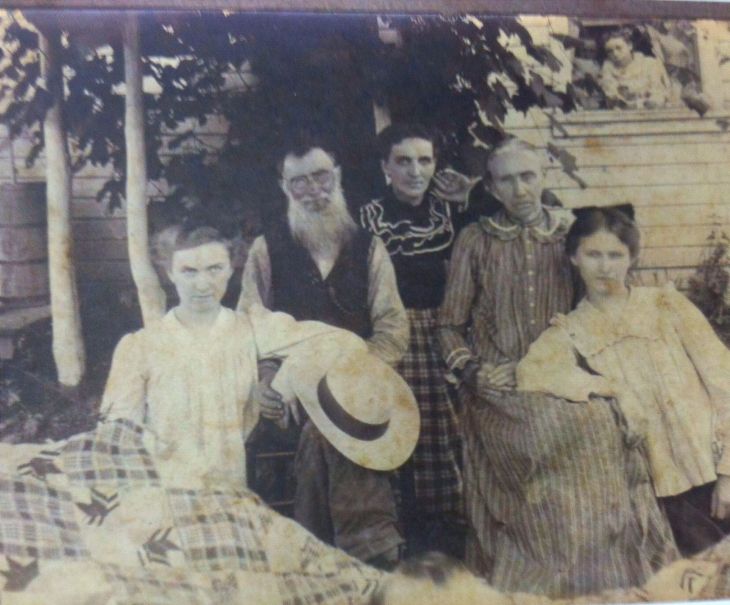
On a whim the other night I googled her name and was struck by a picture of her I had never seen before, uploaded by a cousin. In this one she’s the spitting image of my grandma, lounging under a quilt. She’s leaning on her father’s knee and they’re holding hands. The tenderness is palpable. His face is kind. I suddenly needed to know who this man was, my great great grandfather, who seemed to be looking at me from over a hundred years ago.


I was amazed at what I was able to find and how easily. His name was Zephiniah and he was married once before my great great grandmother. There had to be a story there. The writer in me wanted to write it. The grandaughter in me wanted to know it. For the first time, I felt the call that so many others have felt– just to know.  I clicked and clicked, retracing my steps when I met dead ends and following another branch up the family tree.

As incredible as it seemed initially that I could trace my ancestry back to the 17th century with the touch of a finger tip, that feeling was replaced with the knowledge that that was as much as I could know about these people– their names, spouses, places and dates of birth and death.

I’ll never know who the two people in the window are or why they weren’t in the photo. I’ll probably never know the story about Zephiniah and his first wife. I’ll never know what Christenia was like or how John Spencer’s family came to Virginia. The idea that it isn’t recorded somewhere, that there’s no one on earth who could tell me, that there are stories that are lost, really and truly lost, is almost unfathomable. My mind, so used to the idea that you can find out anything just by Googling it, or at least by Google Scholaring it, almost can’t process the concept that I can know these people’s names and nothing else.

Enough

But maybe that’s enough. Can you imagine John Spencer, a decade after the King James Bible was published, knowing that 400 years later, in California, his great great great great great something granddaughter would say his name?

Maybe, I’ve decided, that’s all we can ask. A part of every person whose name I read was in me before I ever thought about who the individuals were– their blood, their fears, their hopes. The idea that something else could remain– a name, an acknowledgment that they lived, is magic.

Have you been bitten by the desire to know your genealogy? What have you found? Tell me in the comments!