Book Review: On Homesickness by Jesse Donaldson

I like most books I read, on some level. Even if it isn’t my favorite, or if I didn’t like it enough to read the next one in the series, I can usually find something redeeming in everything I read. More than that, I’d say I like most books I read a lot. Maybe this means I’m good at picking books, or maybe this means I like reading enough that I have a very low threshold for enjoyment when it comes to literature.

Every once in a while, though, I pick up a book that sings to me– that speaks so much to me that it feels like it was written directly to my heart.  The Unbearable Lightness of Being, The Wind-up Bird Chronicle, Bird by Bird, Everything Is Illuminated, Even Cowgirls Get the Blues, and now On Homesickness by Jesse Donaldson. I want to hold it to my chest and take deep breaths until it becomes a part of me. It feels like it already is a part of me.

Each page of On Homesickness has the shape, name, and year of formation of one of Kentucky’s 120 counties on the left and a prose poem on the right. The poems detail Donaldson’s nostalgia for his home state from his new home of Oregon. So many of his sentiments give voice to my own feelings about West Virginia in my new home of California. Part of this is because the geography is so similar. We both left Appalachia for the West coast. Part of it is because Donaldson and I are both young married adults with young children. I relate so much to the culture shock Donaldson describes, ache reading the myths and legends he shares about Kentucky because they remind me so much of those from West Virginia, and also felt incredibly invested in his story as it parallels my own.  We have the same cultural references, particularly Wendell Berry. I earmarked almost every other page.

On Homesickness  made me ache in another way– one I didn’t expect. For the first time, I read a book that I so wanted to share with my father. Of course there are lots of things, lots of moments, lots of thoughts I’ve wanted to share with him, but this book…he would have loved it so much. I haven’t felt his loss like this in a while– so fresh. He’s been gone for 19 years now and it hurts that he can’t read it.

Donaldson’s book conveys so many of the feelings and themes I’d like to capture in Rock of Ages so well and I’m so glad I read it while working on the rewrite. This is a book I’ll keep on my bedside and pick up to read a page or two every once in awhile. It has earned its place next to my favorites.

What books feel like they speak directly to you?

Want emails? Sign up here!

Farmhouse Chic: The Rising Trendiness of an Appalachian Aesthetic

Can we talk about appropriation of Appalachian culture for a minute?
Specifically the whole “farmhouse” look as like, a thing. I saw a metal sign in Target the other day that said “Farmhouse.” I don’t think there’s anything inherently wrong with using “farmhouse” as inspiration for a home (and there’s obviously nothing wrong with it if you actually live on a farm). I actually think the look is really beautiful. But I imagine we can all agree that giving money to a big store for a mass produced generic piece meant to imitate the look is literally textbook appropriation, especially if you’re not doing anything to support the regions where the look originates and especially especially if your politics are some of those which keep those regions poor.

I also kind of laugh, thinking about the actual farmhouses I grew up in. I wonder how some of the people who just know the look from Pinterest would feel about the raccoon that made its way into our dryer one time.

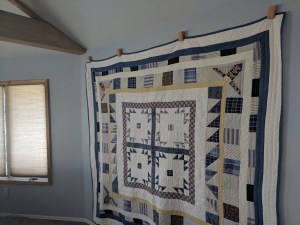
My new home is definitely not on a farm here in SoCal, though I am super excited that we have a bunch of fruit trees and raised beds ready to go, but the interior so far is pretty much just a shrine to West Virginia. It’s all from independent artists or my relatives and friends. The quilt was a wedding gift from a cousin, a combination of chicken feedsacks, my dad’s old shirts, and a quilt top my great grandma pieced. It’s a bear claw pattern for WV.

I’m not trying to be all “more authentic than thou” about it, though I know it might sound that way. I’ll admit it feels kind of nice that I get to be kind of trendy when I’m really just obsessed with my origin story.

I just really can’t wrap my head around paying money to people who pereptuate the exploitation of Appalachia to look like your house is some sterile version of one in Appalachia. If I’m being honest with myself, it bothers me that people might think they can have the beautiful parts of our culture without having, or knowing anything about, the hard parts.

A friend pointed out that the trend may at least give people an appreciation for their own heirlooms and for craftsmanship, and I see her point. Things can be good in some ways and bad in others.

Decorate your home in the way that brings you joy, but please, if your look is inspired by a culture you don’t come from, do your best to learn about and support the people from that culture in whatever way you can.

What do you think? Anyone else try to ease homesickness by surrounding themselves with things from home? What are your feelings about the rise of farmhouse chic?

Settling In, Opening Up: How New Spaces Can Make Space For New Routines (And Vice Versa)

We’ve been in our new house for about three weeks now, long enough to establish some new routines. But it’s all still new enough that I’m aware of the newness pretty constantly. And that newness–that consciousness of newness, leaves a space for newness in myself as well.

When I typed the name of my preferred grocery chain into maps, two came up, both 1.8 miles from our new home. I selected one and drove to it. The next week, when our fridge was starting to look empty again, I drove to the same location. I knew where it was already. I realized this is how years of habits are formed. Though both locations are 1.8 miles from our door, I had already settled on the one that will be “our store.”

For the first couple weeks here, everything I visited– that store, the library, downtown, felt a little bit like an island. I would listen to the navigation on my phone and follow the directions but I didn’t quite see how everything fit together. The map of our new community is starting to piece itself together in my mind now. It’s amazing how our brains can take these bits of spatial information and gradually build a more complete and connected sense of place. Eventually we hold whole neighborhoods, whole cities inside ourselves.

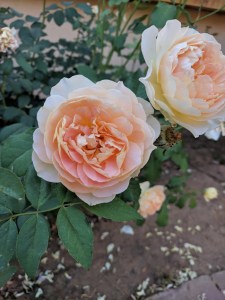
Roses in our new yard

Being in the in-between– being aware of that process– has challenged me to take advantage of this time of neuroplasticity. I’m consciously establishing new routines that I want to be a part of me in this new place– consciously taking good care of our home, turning off my phone before I go to sleep and waiting as long as possible to turn it on in the morning, writing every day, listening to audiobooks, building community.

You don’t have to move to get into this mindset of opening. Just shake up your habits and your routines, the ones that you don’t even think about. Help yourself wake up. Park on the other side of the garage. Sleep on the other side of the bed. Take a different street to your kid’s school. Go to the other grocery store. I think I will next time.

What will you do to turn off the autopilot? What will you create when you do? Please let me know in the comments. I’d love to hear from you!

Be sure to sign up here for emails about blog posts, news, and more!

On Blankenship and Cargo Ships

My novel, Rock of Ages, is about how different the two places I call home are from one another but I want to talk about a big way they’re the same. Their landscapes—physical, human, and economic, are shaped by exploitation, driven by the country’s endless pursuit of convenience at the cost of all else.
Coal is getting some attention. How Appalachia’s butchered mountains sustain America’s demands for endless energy on demand, its dirty rivers growing dirtier while wealthy people far away complain that solar panels are too ugly or that wind power is too noisy.

At home, folks argue that coal is good for the economy. So many jobs! Others remind us that these jobs aren’t sustainable. They aren’t well-paid. They aren’t safe. And yet, Don Blankenship is likely going to win a senate seat.
Meanwhile, here in the Inland Empire of Southern California, I get the same feeling in the pit of my stomach as I drive by the newest in an endless expanse of warehouses being erected.

They have to be talking to each other, these folks. They could switch places and no one would know the difference, their words are so similar. 52,767 jobs, local economist John Husing says, touting Amazon’s positive impact on the region. He doesn’t mention the health risks of these jobs—long hours with no breaks, people working through injuries, nor the environmental impact on the region.

A little background: When people demand fast free shipping of goods, it means the goods have to wait here in the US to be bought. This requires giant warehouses—acres and acres of them. The goods are shipped from China in massive cargo ships, some as long as four soccer fields, and arrive in the ports of Long Beach and LA. Because real estate there is too expensive, the city-sized warehouses are all here, about 60 miles East. Residents get some poor-paying jobs, and pay for them with respiratory health issues caused by the diesel trucks and trains that go back and forth from the warehouses.

Shipping_containers_at_Clyde

Just like West Virginia, the poorest, most vulnerable residents are affected the worst, and are made to feel like they’re lucky because they have access to jobs. Just like in West Virginia, no one tells these folks that their jobs will soon be automated, and they’ll be left without employment, still staring at the giant white buildings in their backyards—as sad a site as a mountain with its top chopped off.

I am guilty. I order things from Amazon. I don’t unplug my cell phone charger. Even knowing all of this, my daily actions feel so far removed from it, it’s hard to bring myself to inconvenience, even a little bit. I think it’s probably one of the inevitabilities of capitalism. But we have to. These aren’t the only places this kind of thing happens. In North Carolina, a town is being overrun by waste product supplying pork products to China. Farmers toil in fields for low wages to bring us the produce we toss into our children’s lunch boxes. Around the world, people and the earth are suffering because it is so hard to make the cognitive connection between the things we consume and their sources.

I’ll always feel that pull to go home to West Virginia—the guilt of escaping when others stayed to make things better. But this is my home now, and there are things I can do to help here too. The warehouses will be built. The coal will be mined. But I can do my best to maintain an awareness of my own consumption and its costs, even though it’s hard. And I can definitely call politicians and economists on their bullshit.