On the Eve of my 32nd Birthday

Tonight I am the exact age that my mother was when she gave birth to me. Up until now, until this day, I thought that she was older when she had had me, as in more of a grownup.

At some point, as a teenager maybe, I asked her when she first felt like a grownup. She told me it wasn’t until she had kids. I birthed my children when I was 27 and 30. I grew up– became a mother– came to embody responsibility and wisdom and sacrifice and love in ways I didn’t understand prior to their arrival. But I didn’t feel like a grownup the way my mom has always been.

My mommy who, since I have known her, just knows how to be the grownup. Who always knows what to do. Who knows the right answers. Who, even in moments of insecurity or uncertainty, embodies those states of being as a grownup– they don’t seem to phase her. She is the most emotionally mature person I know.

There have been a remarkably few times I’ve seen a crack– two that I recall. A vague memory of her upset, throwing a bowl of spaghetti at dinner. My sister and I laughed. And when I was older, a story about being so frustrated trying to find her way somewhere that she turned around and drove hours home. The cognitive dissonance of those stories is jarring– They are so out of place in the image I have of my mom that I sometimes doubt if I remember them correctly.

I know that she probably isn’t as infallible as I see her. I can’t bring myself to delete the “probably” in that sentence– that’s how strong the picture of her is in my mind. I know, realistically, she probably felt just as much like she was flailing her way through early motherhood and everything else as I sometimes do, but even if she didn’t feel like a grownup, as a mother she always acted like the grownup. I aspire to be a mother like that.

I think part of me has held on, thinking my sense of really being a grownup, the way my mom is, would come today. That since I was younger when I had my kids, maybe I just had to wait for today, the day before my thirty-second birthday. Alas, I awoke with the usual patterns of insecurity and impatience still in place.

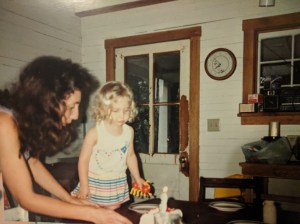
29 years ago

Still, I think there’s something sacred about today, and it isn’t about it being the day before my birthday. There are milestones we don’t acknowledge routinely in our culture. The day you are the exact same age your parent was when you were born is one of them. Being exactly half the age of your parent. Before today, I was less than half the age of my mother. She had lived more than half of her life before knowing me. Tomorrow, and after, that will be less.

I’m listening to Joni Mitchell’s “Both Sides Now” as I type this and it feels incredibly apt– a way to mark this rite of passage. If it weren’t almost midnight I would light a candle.

When I wrote about my father, my mom told me she wished she could know what I would write about her– that she wished she could read it. Here’s what I’d tell her, simply, if this post doesn’t make it clear:

Today, literally, and every other day in every other way:

I measure my life by yours.


I Got Sucked into a Genealogy Black Hole (And You Should Too)

Balthasar. Two Zephiniahs. Christenia. Arzilla.  I whispered my ancestors’ names as I clicked and clicked, tracing my family tree back to the 1620s, to a John Spencer, who lived in Virginia.

Galileo hadn’t yet been forced to renounce the idea that planets orbited the sun. The Taj Mahal had not been completed. It would be another forty years before Milton would publish Paradise Lost, but my boy John Spencer was hanging out in Virginia.

It’s amazing to me that I can know this, that I can sit in my rocking chair in the dark, avoiding sleep, and ask a little magic box who my great grandparents’ parents were. Who their great grandparents were. Who their great grandparents were.

A spark

I’ve never really been interested in genealogy. Despite a vague feeling of connection to a few people in my family’s history, I’ve always kind of feined interest when people tell me about their family trees and even when I’ve seen my own. It was just names. I didn’t know what I was supposed to do with the information or why it really mattered.

Working more on my book, though, has had me thinking more about my great grandmother, my paternal grandma’s mother, Arzilla Mae. Apparently when I was born my dad felt her presence in the room and that knowledge has given me a small fascination with her. I see myself in her pictures. I feel a little like I know her, though she died at age 92, 9 years before I was born.

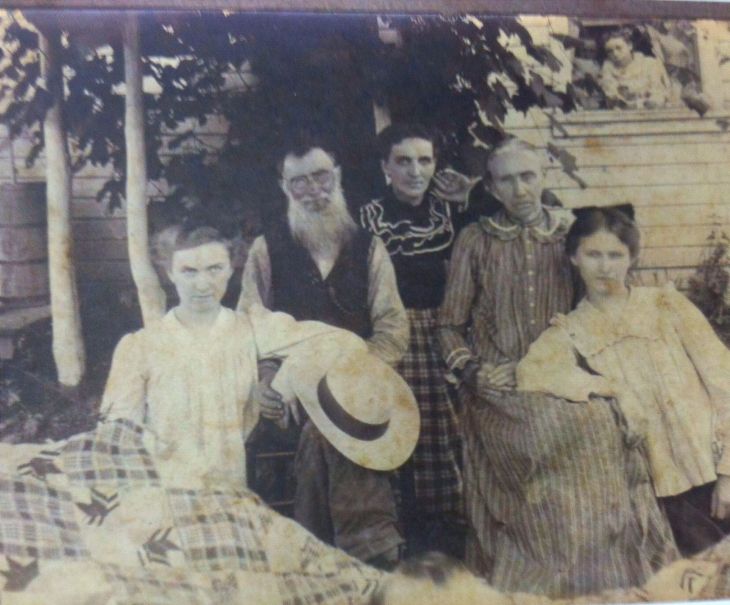
On a whim the other night I googled her name and was struck by a picture of her I had never seen before, uploaded by a cousin. In this one she’s the spitting image of my grandma, lounging under a quilt. She’s leaning on her father’s knee and they’re holding hands. The tenderness is palpable. His face is kind. I suddenly needed to know who this man was, my great great grandfather, who seemed to be looking at me from over a hundred years ago.


I was amazed at what I was able to find and how easily. His name was Zephiniah and he was married once before my great great grandmother. There had to be a story there. The writer in me wanted to write it. The grandaughter in me wanted to know it. For the first time, I felt the call that so many others have felt– just to know.  I clicked and clicked, retracing my steps when I met dead ends and following another branch up the family tree.

As incredible as it seemed initially that I could trace my ancestry back to the 17th century with the touch of a finger tip, that feeling was replaced with the knowledge that that was as much as I could know about these people– their names, spouses, places and dates of birth and death.

I’ll never know who the two people in the window are or why they weren’t in the photo. I’ll probably never know the story about Zephiniah and his first wife. I’ll never know what Christenia was like or how John Spencer’s family came to Virginia. The idea that it isn’t recorded somewhere, that there’s no one on earth who could tell me, that there are stories that are lost, really and truly lost, is almost unfathomable. My mind, so used to the idea that you can find out anything just by Googling it, or at least by Google Scholaring it, almost can’t process the concept that I can know these people’s names and nothing else.

Enough

But maybe that’s enough. Can you imagine John Spencer, a decade after the King James Bible was published, knowing that 400 years later, in California, his great great great great great something granddaughter would say his name?

Maybe, I’ve decided, that’s all we can ask. A part of every person whose name I read was in me before I ever thought about who the individuals were– their blood, their fears, their hopes. The idea that something else could remain– a name, an acknowledgment that they lived, is magic.

Have you been bitten by the desire to know your genealogy? What have you found? Tell me in the comments!

Settling In, Opening Up: How New Spaces Can Make Space For New Routines (And Vice Versa)

We’ve been in our new house for about three weeks now, long enough to establish some new routines. But it’s all still new enough that I’m aware of the newness pretty constantly. And that newness–that consciousness of newness, leaves a space for newness in myself as well.

When I typed the name of my preferred grocery chain into maps, two came up, both 1.8 miles from our new home. I selected one and drove to it. The next week, when our fridge was starting to look empty again, I drove to the same location. I knew where it was already. I realized this is how years of habits are formed. Though both locations are 1.8 miles from our door, I had already settled on the one that will be “our store.”

For the first couple weeks here, everything I visited– that store, the library, downtown, felt a little bit like an island. I would listen to the navigation on my phone and follow the directions but I didn’t quite see how everything fit together. The map of our new community is starting to piece itself together in my mind now. It’s amazing how our brains can take these bits of spatial information and gradually build a more complete and connected sense of place. Eventually we hold whole neighborhoods, whole cities inside ourselves.

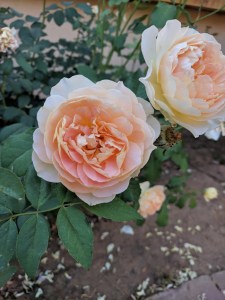
Roses in our new yard

Being in the in-between– being aware of that process– has challenged me to take advantage of this time of neuroplasticity. I’m consciously establishing new routines that I want to be a part of me in this new place– consciously taking good care of our home, turning off my phone before I go to sleep and waiting as long as possible to turn it on in the morning, writing every day, listening to audiobooks, building community.

You don’t have to move to get into this mindset of opening. Just shake up your habits and your routines, the ones that you don’t even think about. Help yourself wake up. Park on the other side of the garage. Sleep on the other side of the bed. Take a different street to your kid’s school. Go to the other grocery store. I think I will next time.

What will you do to turn off the autopilot? What will you create when you do? Please let me know in the comments. I’d love to hear from you!

Be sure to sign up here for emails about blog posts, news, and more!

Blurring the Lines Between Self-Publishing and Traditional Publishing


I spoke recently on a panel on “The Art of Publishing” alongside a self-published author, an author with books both traditionally and self-published, the editor of a weekly newspaper, and the owner of a small press. More than anything, this conversation led me to consider the labels we use when discussing different means of publication. A vast amount of information is available on “traditional publishing vs. self-publishing.” You can consider the pros and cons of each, their histories, statistics, and anything else you could possibly want to know to help you decide which road to go down. I certainly imagined myself standing at a forked path with manuscript in hand while I was obsessively pouring over those sites.

What these blogs and Facebook posts don’t convey is that these are not the only two publishing routes that exist, and that increasingly, the other options are blurring the boundaries between what seemed like two distinct choices.

Traditional publishing used to just be “publishing.” There were a limited number of people in the world who had access to the physical resources needed to print and distribute a book. If you wanted to publish your writing, they acted as the gatekeepers. Of course people have hand-written and distributed writing for a long time, but publishing houses, with Richard Hoe’s patent of the first rotary press in 1846, could circulate paperbacks, introduced to the United States only one year earlier, widely.

Technology– accessible word processors, printers, computers, the Internet—made it possible for a vast number of people to create, replicate, and distribute their work on a broad scale. The self-publishing/ traditional publishing dichotomy was born. Large publishers were no longer required in order to access these tools, and their role changed to that of a content filter and voucher. They came to be seen as quality control—a way to sort through the enormous sea of work that was now available around the world.

But there is more good work out there than the Big Five publishers can publish. Small publishers began challenging that monopoly and filling some of that gap. Even with the numerous small presses that now exist, there is still more great writing, and potentially great writing, than they can manage. Publication sometimes relies on politics—who you know, how much money and access you already have, etc., as a filter because publishers are humans and humans can only read, edit, design, market, and distribute so much. But anyone has access to these tools. People can publish their work themselves. And a lot of it is good! What challenges outdated ideas about the connection between publishing and quality even further is that increasingly folks are choosing to publish their work independently not as a compromise or act of settling, but intentionally. There are a number of reasons some prefer to publish books themselves, including viewing it as a middle finger to the politics and gatekeeping of traditional publishing.

So publishing is no longer necessarily about who can physically publish and distribute a book. And it’s no longer necessarily an indicator of quality. Where does that leave us?

With choices! Here we are again at that fork– You can pursue traditional publishing with a large house or small press or you can publish your book yourself. But there are choices now that blur the line between these two. My first novel, Rock of Ages, is in production with Inkshares, a crowdfunding platform for books. In this model, authors who secure 750 preorders within a set timeframe receive publishing services from the company including cover design, developmental and copyediting, marketing and distribution. Crowdfunding puts the key to that golden gate in the hands of authors. Instead of standing like a sentinel in front of the opening, platforms like Inkshares step aside and ask “Can you reach high enough to unlock the gate yourself?”

The new venture Writing Bloc is taking on, the cooperative publishing model, is taking that a step further. We’re working as a team to write, edit, design, market, and distribute our own work. Like self-publishing, we’re eschewing the need for someone to do it all for us. Instead we’re utilizing the expertise and work ethic of our group as a unit to publish our own quality content. We are taking ownership of the gate and everything inside. But at what point does this kind of venture become more like traditional publishing than self-publishing? After all, we are developing contracts, establishing content guidelines, and hopefully will eventually be distributing royalties. As Robert Batten writes, “publishers are people.” Batten is emphasizing that in order to get in with the company, The Entity, you must first win over the people who make up that entity, but remembering that publishers are people also challenges their hegemonic power.  Publishing houses are not gods. They no longer have a monopoly on resources and they’ve never had a monopoly on quality. They are groups of people who remain the gatekeepers simply because they’ve appointed themselves such and we’ve continued to go along with it.  So does it matter when we cross that line when the line is increasingly arbitrary?

What it boils down to is that the labels are becoming irrelevant. I made a comment on the panel that had all of the participants nodding. One of the amazing advantages of having access to many means of publishing means that you don’t have to write to a target audience if you don’t want to. You can write the book that you want to write—the story that needs to be written—and then find your target audience. When you put your book out into the world you want editing, design, marketing, and the validation that comes from people enjoying your work. Increasingly, those are at our fingertips in a number of innovative configurations. You may not have an audience of tens of thousands. But amongst the billions of people in the world, you probably have an audience of at least hundreds. What is important is creating exceptional books and getting them into the hands of people who will find meaning and value in them, however we do that.


On Blankenship and Cargo Ships

My novel, Rock of Ages, is about how different the two places I call home are from one another but I want to talk about a big way they’re the same. Their landscapes—physical, human, and economic, are shaped by exploitation, driven by the country’s endless pursuit of convenience at the cost of all else.
Coal is getting some attention. How Appalachia’s butchered mountains sustain America’s demands for endless energy on demand, its dirty rivers growing dirtier while wealthy people far away complain that solar panels are too ugly or that wind power is too noisy.

At home, folks argue that coal is good for the economy. So many jobs! Others remind us that these jobs aren’t sustainable. They aren’t well-paid. They aren’t safe. And yet, Don Blankenship is likely going to win a senate seat.
Meanwhile, here in the Inland Empire of Southern California, I get the same feeling in the pit of my stomach as I drive by the newest in an endless expanse of warehouses being erected.

They have to be talking to each other, these folks. They could switch places and no one would know the difference, their words are so similar. 52,767 jobs, local economist John Husing says, touting Amazon’s positive impact on the region. He doesn’t mention the health risks of these jobs—long hours with no breaks, people working through injuries, nor the environmental impact on the region.

A little background: When people demand fast free shipping of goods, it means the goods have to wait here in the US to be bought. This requires giant warehouses—acres and acres of them. The goods are shipped from China in massive cargo ships, some as long as four soccer fields, and arrive in the ports of Long Beach and LA. Because real estate there is too expensive, the city-sized warehouses are all here, about 60 miles East. Residents get some poor-paying jobs, and pay for them with respiratory health issues caused by the diesel trucks and trains that go back and forth from the warehouses.

Shipping_containers_at_Clyde

Just like West Virginia, the poorest, most vulnerable residents are affected the worst, and are made to feel like they’re lucky because they have access to jobs. Just like in West Virginia, no one tells these folks that their jobs will soon be automated, and they’ll be left without employment, still staring at the giant white buildings in their backyards—as sad a site as a mountain with its top chopped off.

I am guilty. I order things from Amazon. I don’t unplug my cell phone charger. Even knowing all of this, my daily actions feel so far removed from it, it’s hard to bring myself to inconvenience, even a little bit. I think it’s probably one of the inevitabilities of capitalism. But we have to. These aren’t the only places this kind of thing happens. In North Carolina, a town is being overrun by waste product supplying pork products to China. Farmers toil in fields for low wages to bring us the produce we toss into our children’s lunch boxes. Around the world, people and the earth are suffering because it is so hard to make the cognitive connection between the things we consume and their sources.

I’ll always feel that pull to go home to West Virginia—the guilt of escaping when others stayed to make things better. But this is my home now, and there are things I can do to help here too. The warehouses will be built. The coal will be mined. But I can do my best to maintain an awareness of my own consumption and its costs, even though it’s hard. And I can definitely call politicians and economists on their bullshit.