
Though you’ve likely heard of NaNoWriMo, you may not know about NaNo Rebels. These are writers who participate in the month-long writing marathon, but don’t follow the rules. They may write essays or nonfiction instead of novels, they may set a word count other than 50,000. They may work on more than one project at once. Or they may revise instead of writing something new. Since I’m knee-deep in the edits for Rock of Ages, if I participate in NaNoWrimo this November, it will be as a rebel. I love the excitement of the month and the tools the program offers, but other than posts on the site’s forums and a few blog posts, I haven’t found tons of resources for participating as a rebel. If you’re planning to use the month to revise, read on for my plan.
Using the Word Tracker
This is the main topic of discussion amongst revision rebels. How do you translate 50,000 words into editing? People tend to do one of a few things: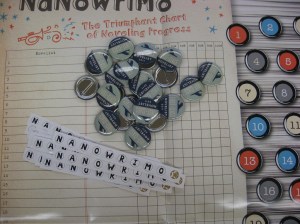
- Words processed- Count each word of your old manuscript that you go through
- Words in the new version- Count the words in your revised work, even if some are copied and pasted or only changed a little bit. These first two are useful if you’re working on a new vomit draft.
- Daily work- Some people aim to work on their revisions each day for the month. Each day you work, add 1667 words to your count.
- Time- 1 hour= 500 words, 1 hour= 1000 words, 1 hour= 1667 words, etc. Since I’m trying to slow down and be more deliberate for this draft, this is likely the way I’ll go, though I haven’t decided my time to words ratio yet. A bonus to using this method is that you can count things like research toward your goal. It also leaves room to go over the same passage multiple times without hindering your word count.
Word Sprints
Word sprints are one of the most helpful tools for me when I’m aiming for quantity. These timed sprints often take place on Twitter, but you can do them with a writing friend, too! They help you circumvent your inner editor and get the words flowing. If you’re trying to summon your inner editor, though, you don’t want to suppress her. Here are some ways to harness the energy of a word sprint if you’re revising:
- If you’re counting words processed or words in your new version, go ahead and race! You can always go back and edit your edits whe the sprint is done.
- Use it as a focus tool. Ban yourself from looking at or doing anything else for the five, ten, or twenty minutes of the sprint. Even if you just sit there staring at your manuscript, don’t give in to distraction for the set amount of time. Maybe you’ll get something done, or maybe you’ll give your brain enough of a rest that you’ll be able to focus more afterwards.
- Use it as a break. Give yourself the time of the sprint to work on something new or to do some stream of consciousness writing. You won’t feel guilty that you aren’t getting your revision done because, hey, it’s just a few minutes, and the excitement of writing will likely re-energize you when you return to your draft.
- Use it for character or world building work. Use the time to write freely about a character’s arc, a scene from their childhood, or a discussion between two of your characters. Write a scene from your world that isn’t in the book. Describe how part of it looks, feels, smells, sounds, and tastes. Write one of your scenes without people. Write one from a different character’s point of view. All of this will help you shape your actual manuscript even if it doesn’t end up in the final version of your book.
Rejoice, Rebel!
Don’t feel guilty about being a revision rebel. NaNoWriMo is a tool to help with your writing. If it’s working for you, then you’re participating, even if you aren’t doing the classic 50,000 new words in 30 days. One of the best parts is the community! So gather your friends, attend a write in, enjoy the forums and the Twitter chat. Sense the buzz in the air that is the worldwide writing community feeling motivated and excited. Happy Almost NaNoWriMo!

 My first draft was my “vomit pass.” Touted by folks like Judd Apatow and Lena Dunham, and encouraged by the structure of marathon writing programs like NaNoWriMo, this is the idea that you just have to get the words down. They don’t have to be good. They don’t even have to make sense. You just have to suppress the urge to edit as you go and get a lot of words on the page. For Rock of Ages, this was about 50,000 words of stream of consciousness writing. I got out stories from my own life as well as some based on family stories and my dad’s poetry. It was definitely a mess, definitely not cohesive, but I still think there were some gems in it. There was emotion in it and it was honest.
 Years later I came back to this jumbled mess and decided to make something of it. I laid each of the stories out on an index card and moved them around until they were in an order that made sense. I filled things in to make a plot– a string that tied one story to the another. At this point I was pretty convinced I was a genius. When I read authors talk about how bad their early drafts were, I thought I was one of those rare writers with extraordinary natural talent. This book would be a classic, I thought, and I’d already done most of the work on it.
 Now sufficiently confident, I sent my book out to some beta readers, who responded well. Bolstered by their approval, after another long break (to have some babies), I started doing some line editing. I changed sentences to make them read better and fixed some spelling mistakes. This round was easier, but much less exciting. This is the draft I sent to Inkshares.
 So now I’m back to step two again– improving the vomit draft. I’m switching from first to third person. I’m overwhelmed by this huge task, but not upset about it. I needed to use first person to get into my characters’ heads and write them authentically and now I need to use third person to improve the prose. I’ll be working on my descriptions, on making them even more authentic for their time periods. I’ll be working to make my book very literary– not just the meanings of the words but the words themselves, their sounds, will invoke the feelings I want to convey. I’m taking it all to another level.


 There’s also a difference in that the act of writing is how we practice and get better. Focusing on a numeric goal can be a good way to just get some words on the page and get out of your head about getting them perfect. The word count goal of NaNoWriMo is what motivated me to write my first draft! So there’s definitely something to be said for getting your words in.
 Unless you are able to devote the bulk of your day to your craft, it’s important not to compare your routines to people who can. If you’re whipping out 500- 1,000 words a day and taking care of children or doing another job, or really, anything else, you’re doing a fantastic job! And if you aren’t, think of Tom Wolfe!
 beccaspencedobias.com